
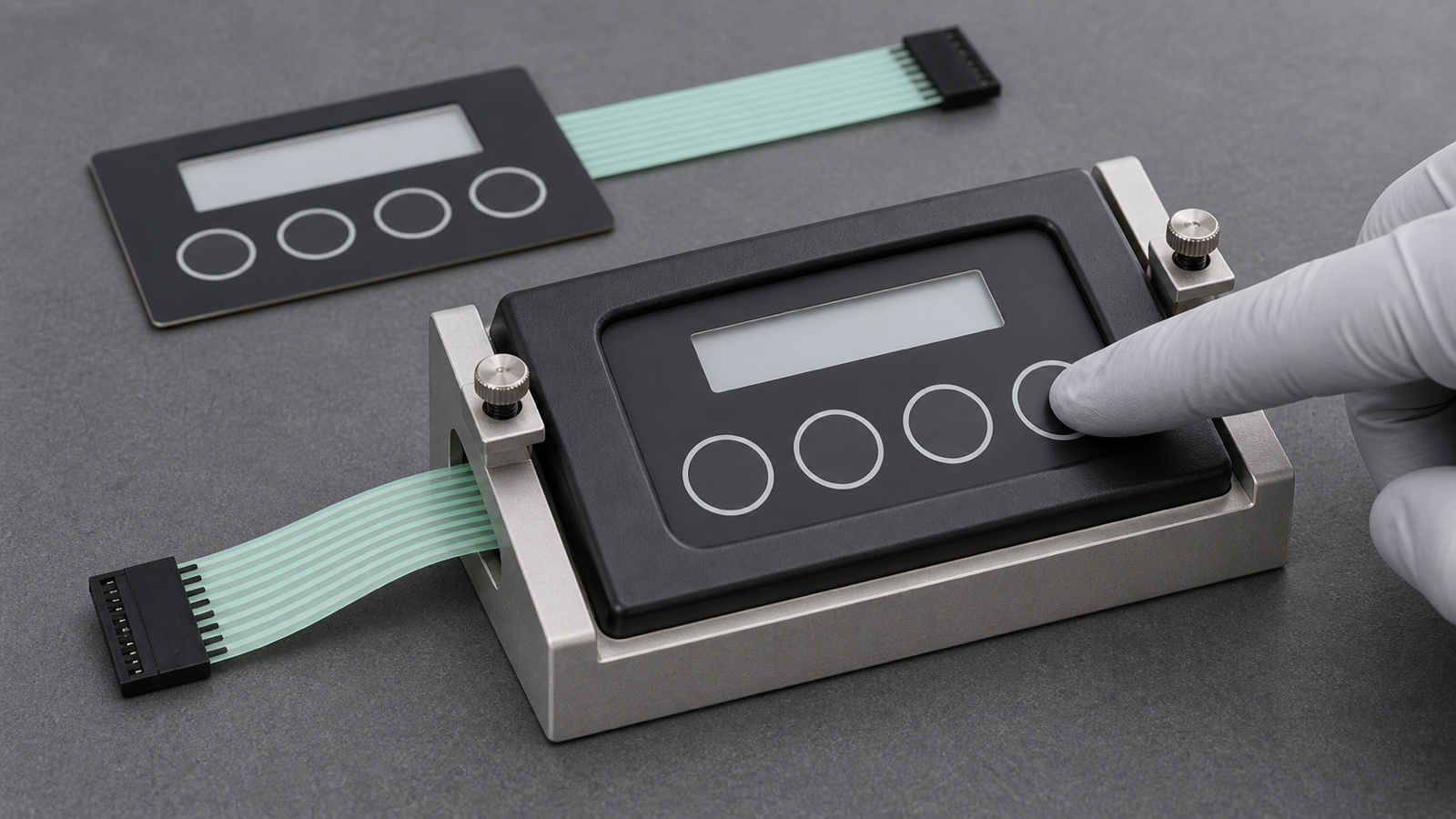
If an automotive membrane keypad clicks differently after mounting, do not immediately reject the switch or approve a replacement supplier. First compare the loose and installed behavior using an identified reference assembly. A bezel pressing on an active area, uneven backing support or a changed attachment stack can alter what the finger feels. The priority is to separate a component difference from an installation difference, then verify that the key releases and registers correctly. Record the condition that changes the symptom before requesting a new construction. A matched artwork or a satisfactory loose click cannot identify the cause of an installed complaint.
A haptics discussion is also a supplier-control problem
In its September 10, 2026 discussion of automotive interior haptics, Driving Vision News connected its own Köln workshop reporting with preparations for a Detroit industry event. The discussion emphasizes specifying and integrating tactile interaction early, alongside cockpit architecture and design. It is an industry discussion, not a new mandatory acceptance standard or a test report for a particular keypad.
That distinction matters when an automotive control supplier changes. A component can resemble the approved part while behaving differently after installation. Procurement therefore needs an acceptance method that follows the interface into its mounting conditions, rather than treating a loose sample as the complete user experience. The source does not identify a Baoshengda product or establish any supply relationship.
The sourcing question is narrower than whether cars should use buttons or screens. Once an equipment program has chosen a membrane-keypad interface, what evidence makes a replacement consistently acceptable? The useful response to renewed attention to haptics is a controlled comparison, not a promise that one switch construction will suit every cockpit.
Keep the mounting stack constant before comparing feel
Start with a reference assembly whose revision and condition are known. Record the bezel opening, panel recess, supporting surface and attachment method. State whether the comparison uses the actual production housing or a fixture representing only part of it. A fixture can help isolate a component difference, but its limitations belong in the approval record.
The film face should not be treated as a free-standing rigid plate. If the backing support is different between two samples, part of the finger movement may be taken up by panel deflection. If a bezel presses on an active area, the sample may already be loaded before the user touches it. Either condition can make an otherwise useful comparison misleading.
Use the same agreed installation procedure for reference and candidate. That includes the adhesive arrangement where relevant, support placement and fastening sequence. Follow the equipment drawing for assembly settings; do not invent a universal tightening value. Record any deviation rather than compensating by hand until the candidate feels acceptable.
The membrane supplier should see the boundaries that affect the part. A front artwork file alone does not show the backing gap, the edge of a bezel opening or the location where a flexible tail exits. Those interfaces can matter more to an installed comparison than a small cosmetic difference in a sample photograph.
Separate a changed switch from a changed installation
A buyer should be able to explain why a sample was rejected. “Feels wrong” is a starting observation, not an actionable disposition. Compare the same key positions and pressing locations, including release, with the same assessment method. If instrumental force-and-travel measurements are required, agree the fixture, contact shape, test speed and acceptance criteria before collecting results. No numerical limit is universal across these assemblies.
| Observation during comparison | What it can indicate | Useful next check before approving or rejecting the supplier |
|---|---|---|
| Both parts feel similar loose, but differ in the bezel | Installation conditions or construction interaction may be important | Compare support, recess and clamping with the same reference hardware |
| The candidate is inconsistent between key positions | Local support, key construction or alignment may differ | Map the affected locations and repeat with the agreed pressing position |
| A key returns poorly only after fastening | Preload, trim contact or stack interference needs investigation | Inspect the mounting boundary under the equipment team's controlled procedure |
| Feel is acceptable but the input does not register consistently | Mechanical sensation alone has not demonstrated electrical operation | Check the agreed key map and electrical acceptance method on an authorized test setup |
| One hand-built sample passes, but later samples vary | The approval may not represent the proposed production process | Request identified first-lot samples and compare using the same assembly and criteria |
These are investigation routes, not diagnoses. A changed symptom after an assembly adjustment does not by itself prove the component was correct or defective. Keep observations separate from the cause assigned after inspection.
Change one condition, then repeat the comparison
Begin with a documented complaint: which key, which pressing location, which assembly revision and what happens on release. Compare the approved reference and candidate in the same identified fixture. Then compare their loose condition separately, without treating either loose result as an installed acceptance. If a symptom appears only under the bezel, move the investigation toward the mounting interface rather than immediately changing the tactile element.
Have the responsible equipment team inspect one permitted assembly variable at a time using its controlled procedure. Examples include whether the backing is seated correctly, whether the opening overlaps an active region and whether the specified attachment has been reproduced. Record the configuration before and after each comparison. Do not loosen a finished vehicle assembly arbitrarily or use a hand-adjusted sample as a production approval.
A change that removes the complaint is useful evidence, not a completed root-cause analysis. Confirm the suspected mechanism against the drawing and inspect whether the adjustment affects release, electrical response or another key. If the reference and candidate still differ under the same controlled conditions, the supplier has a more specific component question to investigate.
A practical drawing and sample package contains:
- The current keypad construction revision, key-position map and required electrical interface.
- The bezel opening, recess, backing-support drawing and controlled installation method.
- An identified reference part and the candidate samples, with any prototype-to-production differences declared.
- A location-by-location record of pressing, release and electrical observations, plus the agreed acceptance method.
- The intended environment, sample and production quantities, and the person or team authorized to approve a deviation.
Close the complaint with an identified cause, an authorized corrective action and the repeated comparison result. If the cause is still uncertain, preserve that uncertainty rather than accepting a new supplier on the basis of one successful hand-built sample. Any permanent change to the supporting housing or switch construction needs the program's revision and acceptance process.
Send the supplier the interface, not just the artwork
Baoshengda's automotive membrane-switch and HMI component options provide a starting point for reviewing a proposed control surface. We can review component drawings, interface inputs and the requested sample scope, and identify information still needed for a quotation. The specific construction, test responsibilities and acceptance evidence must be agreed for the project.
The component review does not establish whole-vehicle human-factors performance, functional safety, software behavior or approval for a driving task. Those remain part of the equipment program's system-level evaluation. Nor does the generated cover demonstrate a measured click force or a production-approved assembly; it illustrates why the mounting boundary belongs in the comparison.
For an installed-feel complaint, send the reference and proposed assembly scope for review. Include the existing keypad revision, representative mounting details and the difference you need to resolve. That gives us a clearer question than “please match this button”: determine which part and installation conditions the replacement must reproduce, and what evidence will close the approval.
Need help reviewing a structure?
Send your drawing, photos, application, and quantity. Baoshengda can help check the structure before sampling.
Send Drawing for Quote