Wireless Charger Status Panels: Keep Adjacent Indicators Visually Separate
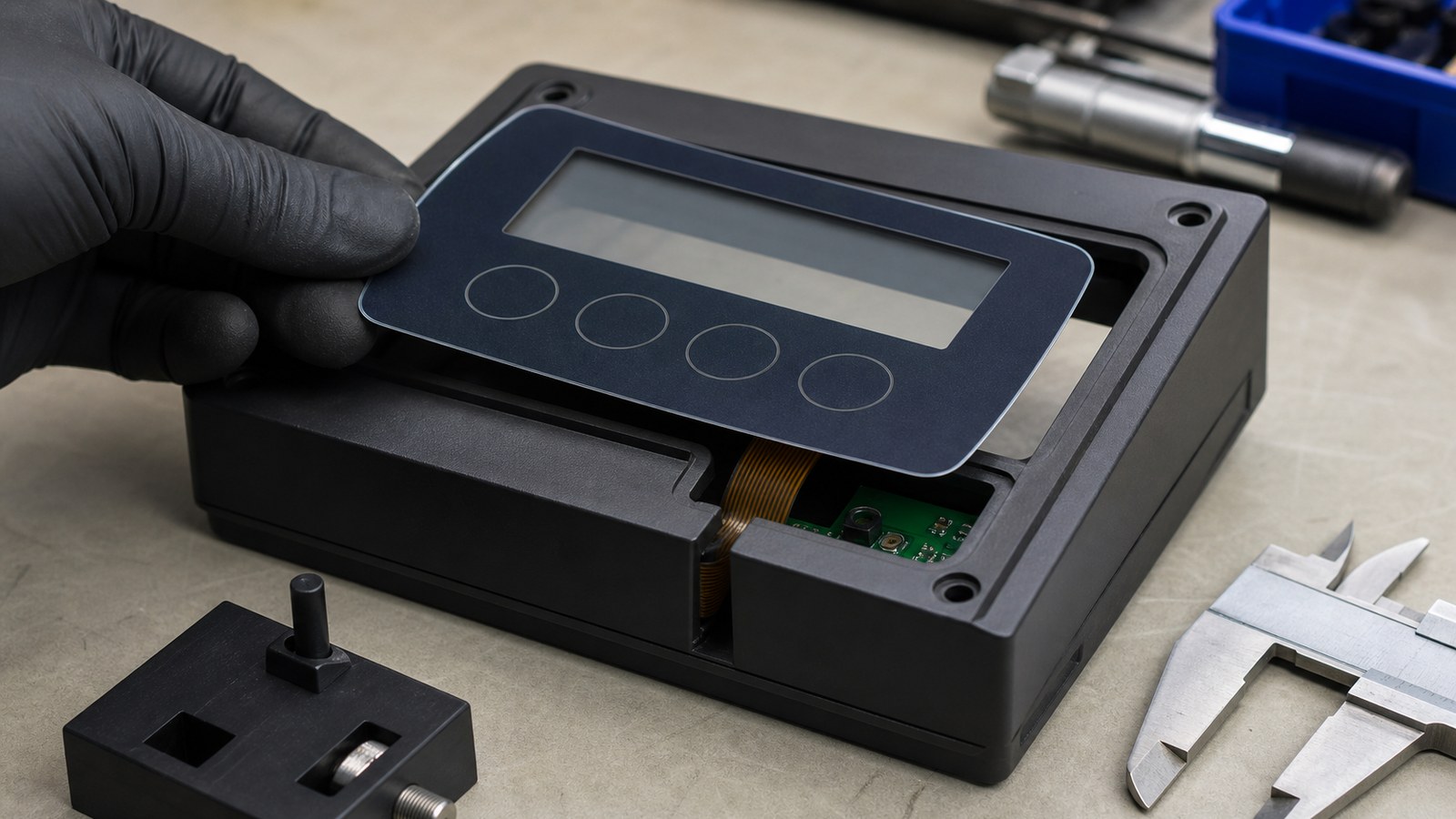
A brighter LED cannot fix every misleading status window. Compare the light paths and inspect unlit neighbours before approving the mounted panel.
Read guide
Insights
Use these articles to prepare drawings, compare materials, reduce sampling changes, and communicate requirements more clearly before quotation.
Topic cluster
Backlit, waterproof, FPC and general membrane-switch design and sourcing guides.
A brighter LED cannot fix every misleading status window. Compare the light paths and inspect unlit neighbours before approving the mounted panel.
Read guideAllocate schedules and account workflows to the app, then keep only equipment-side actions that need a stable local response on the charger panel.
Read guideClassify control-panel redlines as visual, electrical, mechanical or system-owned before reusing tooling, comparing quotes or approving samples.
Read guideSeparate control-panel fit, tactile, circuit and connector checks from optical output, software and finished-device evidence before sample release.
Read guideA replacement panel can look correct and still break the released interface. Freeze physical, electrical, mounted and software-boundary evidence before requesting samples.
Read guideFreeze local maintenance states, control authority, sealing and interconnect evidence before approving a waterproof keypad sample for a multi-site BESS cabinet.
Read guideReplace a broad PFAS checkbox with a revision-linked front-panel stack, declaration scope and evidence owner before sample approval.
Read guideA replacement front can match the keypad yet fail inside the housing. Control the FPC tail route, connector handoff and service sample before approval.
Read guideA cabinet can warm its air while a door edge, window or terminal area remains below the local moisture limit. Build the heater RFQ around the cold surface and its acceptance test.
Read guideSeparate static contact, shape recovery and alarm logic, then approve the long pressure strip through flat, curved and mounted sample stages.
Read guideA compact keypad can stay simple only when its mounting zone, adhesive edge and tail transition are kept outside uncontrolled movement.
Read guideAn early-warning model does not define the local service panel. Convert each storage fault into a visible state, permitted action and testable response.
Read guideA colored alarm lamp is not an action map. Separate acknowledge, silence, reset and test functions before the medical HMI artwork is approved.
Read guideA smooth optical roughness profile does not prove that the finger, dome, print layer or adhesive sees the same surface. Freeze the reference sample and measurement workflow.
Read guideA material can pass thousands of flat bending cycles and still fail when the tail crosses a rib, boss or connector pocket. Test the mounted route, not only the coupon.
Read guideA charging robot automates the process, not the operator handoff. Freeze the manual-override states, status lamps, key matrix and connector before sampling.
Read guideContinuity after a static bench test can hide trace cracks, flaking, peeling and loose contacts. Add mounted shock, vibration and tail-cycle checks before approving an FPC sample.
Read guideChoose the tail termination before sampling, with clear ownership for contacts, housing, mating part, routing, retention and validation.
Read guideA mounted-sample method for checking ZIF seating, service-loop pull, latch retention and pin continuity after the housing is closed.
Read guideMap center, edge, corner, window-side and tail-side keys before a membrane switch sample is approved.
Read guideA sample-approval method for separating harmless tail bends from creases, intermittent conductors and housing-exit damage.
Read guideA practical RFQ guide for aligning indicator windows, LED circuits, tail pins, key zones and sample approval.
Read guideA source-led tradeoff for mapping heater keepouts, trace paths, power leads and cold-point tests inside battery and UPS cabinets.
Read guideA practical guide to aligning contact fingers, stiffener geometry and ZIF connector engagement before keypad samples.
Read guideA drawing-control guide for keeping keypad functions, FPC contacts and PCB connector pins aligned through revisions.
Read guideA buyer-focused RFQ evidence guide for FPC membrane switch projects that need a ZIF connector tail and compact housing route.
Read guideOutdoor EV charger control panels need RFQs that connect night readability, wet operation, service access and tail routing before sampling.
Read guideCompact robot panels often fail at the tail exit, not at the printed key area. Use this guide to review bend radius, stiffener length, ZIF access and sample evidence before tooling or repeat builds.
Read guideBacklit membrane switch samples need more than an electrical pass. Buyers should review LED zones, light leak, hot spots, diffuser choices, housing fit, and RFQ evidence before approving the first sample.
Read guideAn FPC membrane switch can fail at the tail before the keypad surface shows any problem. Buyers should confirm bend radius, ZIF fit, stiffener length, and housing route before sampling.
Read guideCheck viewing angle, LED hot spots, light leaks, overlay color, and housing fit before approving a backlit membrane switch sample.
Read guideBefore choosing LED or EL backlighting, buyers should define viewing conditions, panel thickness, power limits, light uniformity, and service-life expectations.
Read guideFor service tools and portable controllers stored in hot vehicles, buyers should confirm first-press feel, tail routing, window pressure, and mounted heat-soak behavior before approval.
Read guideWhen outdoor equipment faces sun load, humidity, and sudden rain, buyers should confirm edge sealing, tail-exit protection, adhesive behavior, and assembled-sample checks before approving a waterproof membrane switch.
Read guideWhen outdoor controllers face heat, humidity, and tight enclosure space, buyers should confirm FPC tail routing, connector fit, bend radius, sealing, and assembled-sample behavior before approval.
Read guideCheck artwork, housing fit, tactile feel, tail routing, adhesive contact, windows, and inspection records before releasing a membrane switch sample to production.
Read guidePrepare drawings, housing photos, connector details, button feel, and real use conditions before asking for a membrane switch quote.
Read guideMany membrane switch failures show up at the tail, not on the keys. A short guide on tail exit direction, length, reinforcement, and which connector your housing actually wants.
Read guideReview sealing, tail exit, adhesive, window, and inspection factors for wet environments.
Read guideUnderstand PET, PC, overlay finish, adhesive, circuit choices, and environment factors.
Read guideTopic cluster
FSR pressure sensing, flexible heating film and integration checks for compact systems.
A cold-resistance match does not prove equal installed heating. Separate incoming checks from mounted thermal evidence before releasing a cabinet-heater substitute.
Read guideMap the exact liner, adhesive, sensor laminate, processing and finished sample to the tested article before using a report for wearable FSR approval.
Read guideFreeze the fixture, stack and circuit, then compare the approved and replacement FSR across loading, release, recovery and repeatability before approval.
Read guideFreeze the contact fixture, signal role and three sample stages before quoting an FSR for robotic connector assembly.
Read guideAn FSR can confirm a defined contact event, but secure-grasp approval needs mechanical, signal and stability evidence from the mounted robot.
Read guideA pressure-sensor curve does not prove stable command control. Lock the actuator, preload, mapping rule and mounted sample test before approval.
Read guideNovel sensor materials detect a signal, not a stable force path. Define how pressure reaches the FSR, where it is supported, and how the cable exits the wearable assembly.
Read guideIf a bedding sensor passes on a flat bench but drifts or becomes intermittent after integration, isolate support, roll lines, conductor strain and the tail transition.
Read guideA heater wattage alone cannot define a rack-mount battery thermal zone. Freeze the surface, heat path, sensor, control boundary and mounted test first.
Read guide“High sensitivity” is not enough for an FSR quotation. Define the load window, actuator, preload, mounting, readout and sample acceptance method first.
Read guideA wearable belt can shift an FSR baseline before the electronics change. Control the mechanical coupling, preload and mounted test states first.
Read guideChoose discrete FSR zones or a dense tactile array by the contact information the robot must recover, not by sensor labels alone.
Read guideA staged method for finding whether an installed FSR baseline moved because of preload, support geometry, cable strain or electronics.
Read guideA source-led selection guide for matching service-robot contact locations to FSR zones, actuators, readout channels and mounted tests.
Read guideA practical comparison for robot teams deciding when an FSR pressure sensor is enough and when calibrated load-cell data is required.
Read guideA component-level guide for battery and UPS cabinet teams choosing flexible heating film placement, controls and RFQ evidence for cold-start recovery.
Read guideTurn a home-monitoring sensor idea into an FSR sample brief with contact area, threshold, cover stack, cable route and test evidence.
Read guideOutdoor energy cabinets do not need heat everywhere. Buyers should define the cold surface, condensation path, sensor position, wiring exit and control limit before asking for a flexible heating film sample.
Read guideAn FSR pressure sensor sample should prove more than force response. Buyers should check tail routing, connector fit, readout circuit, actuator preload, and installed signal stability.
Read guideBefore sampling an FSR pressure sensor, buyers should define force range, calibration method, actuator preload, test fixture, circuit reading, and acceptance data.
Read guideA practical FSR pressure sensor sampling guide for buyers who need stable force readings from the actuator, stack-up, and contact area.
Read guideFor humid outdoor equipment, buyers should confirm border clearing, startup power budget, sensor placement, and installed stack-up before approving a heating-film sample.
Read guideWhen summer heat and humidity rise, buyers should test FSR pressure sensors for drift, recovery time, actuator-stack effects, and threshold stability before locking the sample.
Read guideWhen outdoor equipment faces humid mornings, rain exposure, and fast temperature swings, buyers should confirm anti-fog heating-film layout, warm-up targets, connector routing, and control limits before sampling.
Read guideBefore sampling an FSR pressure sensor, define the force range, contact area, actuator, circuit, calibration method, tail route, and real test conditions.
Read guideTopic cluster
Automotive dashboards, industrial HMI, touch interfaces and installed control-surface decisions.
A matching printed face is not a batch identity. Keep the part, revision and lot reference with the pack that staff actually issue.
Read guideA loose click cannot diagnose an installed complaint. Compare reference and candidate under the same mounting conditions before changing the switch.
Read guideKeep the visual and tactile HMI family consistent while controlling each machine's circuit, tail, connector, mounting and sample evidence separately.
Read guideMissing artwork need not stop the first enquiry. Establish overlay scope, record the gaps, and agree what is needed for quotation, a fit sample and production.
Read guideUse photos to find hot spots and light leaks, then freeze the drive, ambient, viewing, camera and measurement conditions before approving a night sample.
Read guideAssign tablet, teach pendant, fixed local keypad and safety hardware by operator proximity, machine state, repeatability and failure behavior before freezing the panel.
Read guideDefine one owner for shared front-panel datums, sealing, artwork, service keys and flex interconnect while keeping qualified charger modules inside controlled boundaries.
Read guideFreeze the layer owner matrix and one tail-to-connector handoff before a smart-surface HMI moves from visual concept to comparable supplier quotations.
Read guideChoose the supplier boundary only after mechanical, tactile, sealing, optical and tail-to-connector responsibilities are controlled.
Read guideFreeze offline actions, indicator ownership and the complete tail-to-board route before approving a portable-power keypad service spare.
Read guideFreeze one action-state matrix before allocating a dual-mode POS terminal between touchscreen actions and dedicated membrane keys.
Read guideSeparate key legends, locating light and status indicators before quotation so every optical zone has a defined owner, circuit and sample test.
Read guideAI-assisted control does not remove the need for a clear local interface. Freeze key authority, pin mapping and sample evidence before quotation.
Read guideA physical key is not an automatic fix for drop-related touch faults. Approve the front interface through load-path, input and mounted-sample evidence.
Read guideA dashboard photo hides several supply scopes. Freeze overlay datums, input states, revision masters and the safety boundary before pricing a low-volume cockpit HMI.
Read guideUse an installed photo as an open-item index, then close the drawing, revision, mounted interaction, cleaning and service-replacement evidence.
Read guideDefine which maintenance actions stay local, which diagnostics move to software, and what mounted sample evidence a membrane HMI quote needs.
Read guideChoose which home-health actions deserve physical keys, then verify blocked-state feedback, cleaning, reach and flex-tail routing on the mounted sample.
Read guideFreeze recovery authority, hatch sealing, tail routing and wet-use sample evidence before quoting an outdoor robot service keypad.
Read guideSeparate therapy commands, ordinary pause, safety hardware and service authority before quoting a rehabilitation-robot hand controller.
Read guideOCPP test evidence does not approve a charger's local front panel. Split protocol, mounted optical, environmental and service checks before sample sign-off.
Read guideA brownfield HMI quote should separate front-panel replacement, adapter conversion and full control upgrade before a mixed-generation line enters sampling.
Read guideA common EV charger service keypad needs a module-to-panel release matrix, connector-side pin evidence and mounted cross-revision swap results.
Read guideA medical controller panel sample should preserve named alarm states, permitted recovery actions and backup-controller handoff without being mistaken for the safety system.
Read guideA matching outline does not prove a spare works across a robot fleet. Control revision identity, pinout, mounted swaps and rollback before release.
Read guideA medical robot panel can request start or pause, but it should not be mistaken for the safety system. Freeze each path before the RFQ.
Read guideA local EV charger panel can request actions and show states, but it should not own communication security. Freeze that boundary before artwork and samples.
Read guideAssign active viewing-angle control to the display stack and printed masking, window geometry, finish and adhesive to the overlay supplier.
Read guideAn adaptive display can shift views without proving which robot is selected or how motion stops. Keep selection, stop and acknowledgement controls fixed.
Read guideA battery pack can run longer at -30 C while the control panel still fails on condensation, a pinched tail or a leaking connector. Approve each layer separately.
Read guideA haptic research roadmap does not place a dome or set key feel. Map sensing, feedback and command states before the panel artwork is fixed.
Read guideA friendly robot face is not a reliable system indicator. Separate social expression from physical lock, drive and alarm confirmation before freezing the HMI layout.
Read guideA sharper cycle-time model does not place keys. Map reach, prehension and confirmation steps to physical zones, then freeze critical controls and routing.
Read guideNeck-flexion screening can justify a panel change, but the supplier still needs key coordinates, window placement, actuator behavior, tail route and connector data.
Read guideRemote views and local physical controls solve different operator problems. Define authority, loss-of-link states, fixed key classes and mounted handover tests before artwork approval.
Read guideA loose panel can pass inspection and still become hard to read, reach or clean after installation. Use a mounted, room-condition sample plan before release.
Read guideA recovery HMI should show verified vehicle state before it exposes permission or motion controls. Use this drawing, state-matrix and sample checklist to keep the front interface unambiguous.
Read guideVariable returned parts create operator decisions that should not share one control group with machine motion. Use a clear state map, mounted sample test and RFQ boundary.
Read guideA quotation guide for separating front-panel deliverables from buyer-owned electronics, firmware and system validation.
Read guideA source-led application note for separating gateway status windows, setup keys and the complete tail route before mounted sample approval.
Read guideA source-led guide to separating patient, caregiver, operator and service actions on a medical-device control panel.
Read guideA source-led application note for keeping window motion and door locking distinct in compact physical-control modules.
Read guideA sample approval guide for separating printed appearance from illuminated legends in automotive HMI overlays.
Read guideA source-led note for EV charger teams placing screen-adjacent inputs, sealed HMI zones and service controls for the first sample.
Read guideUse a separate HMI service panel when a mobile robot needs fixed reset, status or maintenance inputs outside the main touchscreen.
Read guideUse task frequency, glance risk, glove use and service access to decide where tactile automotive HMI controls still belong.
Read guideAutomotive dashboard overlay samples can look correct on a table but fail after mounting. Buyers should confirm adhesive landing, housing fit, cutout support, heat exposure, and sample evidence before approval.
Read guideTouch-only panels are not always the safest default for automotive HMI projects. Buyers should review feedback, lighting, cleaning, sealing, and sample evidence before freezing the control surface.
Read guideA waterproof membrane switch needs enough front sealing area, stable adhesive landing, and housing fit. Confirm these details before samples, not after leakage appears.
Read guideBefore sampling an automotive dashboard overlay, buyers should confirm icon registration, backlight window fit, display cutouts, adhesive support, and mounted review evidence.
Read guideBefore approving an automotive dashboard overlay sample, buyers should review heat exposure, glare, window fit, backlight readability, adhesive contact, and mounted sample risks.
Read guideOutdoor waterproof membrane switch failures often start at the tail exit or connector. Check sealing, strain relief, mounting paths, and RFQ details before sampling.
Read guideFor outdoor touch switch projects, buyers should test false-trigger control, glove response, edge moisture hold, housing stack-up, and wipe-down recovery before approval.
Read guideFor outdoor service equipment, buyers should confirm anti-glare surface, dead-front contrast, window stack-up, and assembled backlight checks before sampling.
Read guideAs mid-June heat and humidity stay elevated, buyers of touch panels should confirm wet-hand behavior, cleaner resistance, cover-lens stack-up, and edge sealing before sampling.
Read guideAs automation and robotics projects draw attention, buyers should confirm HMI membrane switch structure, tactile feedback, sealing, tail routing, and RFQ details.
Read guideAs mid-June heat and glare return, buyers of outdoor control panels should confirm dead-front readability, sealing, cleaning resistance, tail routing, and backlight details before sampling.
Read guideAs car interiors rebalance screens and physical controls, buyers should confirm dashboard overlay materials, backlit icons, tactile functions, tail routing, and sample checks.
Read guideCompare sealed tactile switches and touch panels from a buyer's application viewpoint.
Read guideTopic cluster
Graphic overlays, PET/PC surfaces, rubber keypads and metal-keypad application guides.
Use a rigid model to check reach and fit, not to approve switch feel. Specify which decisions need a representative membrane-keypad sample.
Read guideTesting every keypad is not the same as testing every required contact state. Agree what the inspection detects and which records travel with the shipment.
Read guideA similar key layout can hide a different supply scope. Decide whether the quote ends at the membrane tail or includes the host controller and firmware.
Read guideA flexible keypad tail is not automatically a hinge cable. Compare a stationary door-mounted termination with a separately qualified dynamic connection.
Read guideA matte touch field and a display window do different jobs. Mark the finish zones and sample scope so overlay quotations describe the same construction.
Read guideChoose a rugged remote keypad from glove movement, command separation, enclosure integration and sample evidence, not from a material label or IP checkbox.
Read guideDecide who owns the film, window, adhesive, touch and display interfaces before a panel-PC supplier transfer reaches sampling.
Read guideSeparate public status from authorised service controls, then freeze mounting, sealing, tail and sample evidence for each cabinet interface.
Read guideCommonize the mechanical envelope only where housing geometry is identical, then control appliance-specific legends, windows, light maps and function evidence.
Read guideSeparate dry contact, mounted-stack, moisture-path, tail and controller evidence before quoting an ultrasonic-cleaner keypad replacement.
Read guideUse a mounted input-to-event test to approve EV charger key mapping, sealing, tail routing and replacement parity before production.
Read guideSeparate keypad contact evidence from alarm-state recovery before approving a patient-monitor replacement panel.
Read guideDefine the dry control keymat, PCB contacts, enclosure compression and cleaning evidence separately from skin-contact and fluid-path silicone.
Read guideA failed resume action does not prove the membrane keypad is defective. Capture contact, connector and controller evidence before sending the replacement RFQ.
Read guideFreeze cabinet-door datums, artwork ownership, adhesive land, golden units and a three-gate sample plan before moving a storage-cabinet overlay to a second source.
Read guideA matching front face does not make a medical keypad a common spare. Freeze the full revision tuple before supplier transfer and service approval.
Read guideA replacement keypad can fit the opening and still break fault recovery. Freeze the state map, pinout, enclosure and mounted test together.
Read guideMatching artwork and dimensions is not the same as matching the bond. Substrate texture, coating, cleaning and adhesive squeeze can change the result even when the drawing does not.
Read guideA console ergonomic study can move controls on screen, but the procurement drawing must freeze key positions, indicator openings, tail pins and artwork revision.
Read guideA START key and a few indicator labels do not define a charger interface. Freeze the command-to-feedback state map, controller boundary and mounted acceptance evidence first.
Read guideChoose one governing revision before a replacement supplier quotes, then separate drawing, artwork, sample and change-record authority.
Read guideA practical method for sizing display windows, black borders and housing openings from the assembled tolerance stack.
Read guideA replacement-sourcing guide for turning a physical overlay sample and housing references into a controlled quotation package.
Read guideA source-led application note for keeping an outdoor charger keypad tail exit and connector outside the enclosure water path.
Read guideA source-led comparison for battery cabinet teams allocating display windows, service keys, adhesive land and mounted-sample evidence.
Read guideA source-led buying guide for placing cleaning robot service keypads away from fluid work while keeping setup, status and maintenance inputs accessible.
Read guideA practical RFQ guide for aligning embossed keys, artwork, windows, adhesive openings and housing references before tooling.
Read guideA source-led application note for home-use medical device teams choosing low-profile FPC membrane switch controls, tail routing and RFQ evidence.
Read guideA practical troubleshooting guide for checking LED layout, diffuser stack, legends, sealing and RFQ evidence on outdoor charger backlit keypads.
Read guideA practical guide for medical device teams freezing graphic overlay artwork, display windows, adhesives and cleaning exposure before sample builds.
Read guideA practical failure-diagnosis guide for PET or PC graphic overlays bonded to ABS housings, with RFQ details buyers should send.
Read guidePET graphic overlays for ABS housings need more than artwork approval. Confirm the housing recess, adhesive landing, display window, tail route, and mounted sample evidence before sampling.
Read guideBefore approving a PET graphic overlay sample, buyers should confirm artwork tolerance, color matching, die-cut fit, window borders, and housing alignment.
Read guideBefore approving a PET graphic overlay sample, confirm cleaning exposure, window clarity, surface finish, adhesive fit, and tail or cutout risks.
Read guideBefore approving an embossed PET graphic overlay sample, buyers should check window alignment, emboss feel, surface finish, adhesive contact, and the mounted review condition.
Read guideFor powder-coated outdoor control boxes, buyers should confirm adhesive contact, wipe-down wear, window clarity, edge silvering, and assembled heat checks before approval.
Read guideFor hot-shift equipment, buyers should confirm rubber keypad rebound, legend durability, contact design, sealing lip, cleaning exposure, and real assembly conditions before approving samples.
Read guideWhen outdoor terminals head into hot, wet service conditions, buyers should confirm panel stack, stud pattern, sealing path, grounding, and cable exit before reordering a metal keypad.
Read guideInteractive displays can look polished on the show floor, but buyers still need to check overlay glare, window borders, cleaning resistance, adhesive edges, and bonding details before sampling.
Read guideFor outdoor terminals, buyers should decide early whether the project needs metal-key durability or rubber-key feel, backlight flexibility, and softer operation.
Read guide