
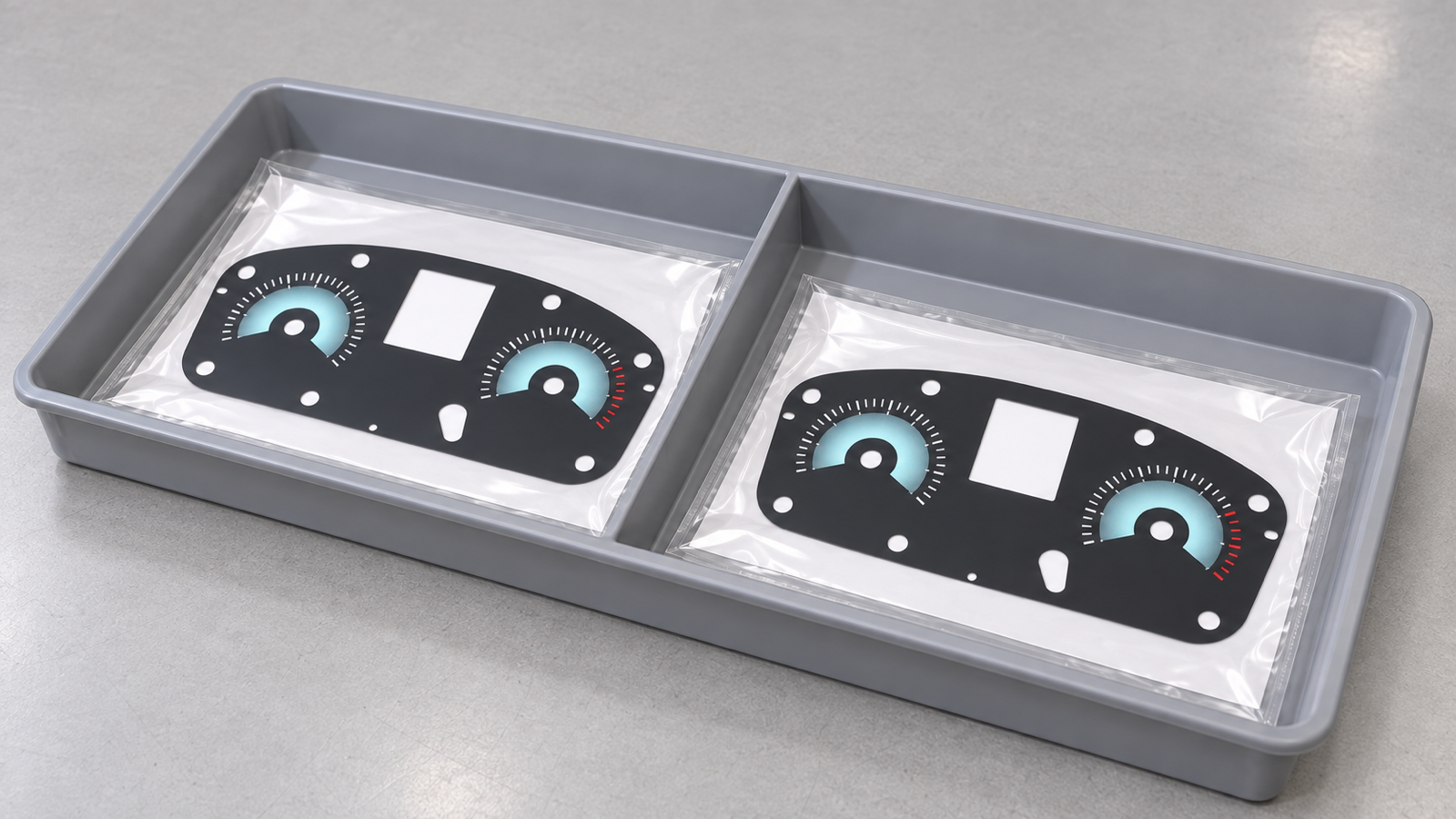
Order commercial-vehicle dashboard overlay spares so that each issued pack retains a known part number, approved revision and supplier batch reference. Do not combine look-alike faces in one unmarked pile, even when their outline and colours appear identical. Ask the supplier how that identity survives carton opening, partial use and a return to stock. A photograph of the current face and your normal order quantities are enough to start this discussion. Before production, agree the approved part definition, pack quantity, label information and receiving checks; packaging cannot establish vehicle compatibility that has not been reviewed.
A matching face is not a stock identity
A dashboard overlay is the printed face component, not the complete instrument cluster or its electronics. Two faces may fit the same broad outline yet differ in a window, printed scale, icon, finish or approved construction. Other differences may not be visible at all. Appearance can help an inspector notice a mismatch, but it is a poor substitute for a controlled part reference.
Keep three identities separate. The part number identifies the ordered item. Its revision identifies the approved definition. The batch or lot reference connects delivered pieces to the supplier's agreed production records. A new batch does not necessarily mean a new revision, and an unchanged revision does not mean every shipment belongs to the same batch.
For a service-spare order, the practical question is what happens after the outer carton is opened. If the only identification remains on that carton while loose films move between shelves, the link to the received batch can be lost before installation.
Prepared workshop parts make small-item control matter
DAF's September 14, 2026 IAA product announcement describes an expanded vehicle offering together with services intended to improve vehicle availability. Its PreDiagnostics discussion says workshop technicians and parts can be prepared before a truck arrives. The same release covers additional diesel and electric vehicle configurations, illustrating why service readiness involves more than a single vehicle specification.
This is a current manufacturer update about its vehicles and service approach, not a statement about the way it buys or packages dashboard overlays. It does not identify Baoshengda as a supplier, specify a replaceable overlay, or establish a packing requirement for another manufacturer's vehicles.
The procurement lesson is narrower: when a service operation prepares parts in advance, correct part identity has to survive the journey from receiving to the prepared job. For an OEM or service-parts organisation that already has an approved overlay replacement scope, segregated packs are one way to reduce avoidable picking ambiguity. They do not replace the vehicle maker's compatibility and service instructions.
Give the smallest issued pack a usable identity
Specify identification at the level that staff actually issue. If technicians normally take one overlay at a time, discuss whether individual identification belongs on a protective sleeve or removable carrier. If the operation issues a small sealed group, define that group and how a partly used pack will be handled. Individual packing can cost more and use more material; larger packs require more discipline after opening.
Do not add a permanent mark to a visible dial face simply to solve a warehouse problem. Its location and effect on appearance or function would need approval. A pack label, approved carrier marking or another agreed method may preserve the reference without changing the public-facing artwork.
| Receiving situation | Evidence to retain | Release or segregation decision |
|---|---|---|
| Same part and revision, one declared batch | Pack identity and matching delivery record | Keep the identity with the smallest issued pack |
| Same approved part, several declared batches | Separate batch references and quantities | Keep batches physically identifiable after opening |
| Look-alike parts with different revisions | Each approved drawing reference and pack identity | Store and issue as separate items unless interchangeability is explicitly approved |
| Loose return with missing identity | Available issue history and the physical item | Hold separately until identity and condition can be established |
A tray divider or separate shelf helps people avoid mixing pieces. It does not prove which part is inside. The physical separation and the documentary link must work together.
Check the shipment without destroying its separation
At receipt, reconcile the order, delivery information and actual pack labels before spreading parts across a common bench. Confirm the declared part, revision, batch references and quantity. Use the agreed inspection plan to check representative pieces against the approved sample or drawing, keeping every opened piece associated with its original pack.
For the overlay itself, relevant checks can include the printed face, window and hole positions, edge condition and agreed surface appearance. If the supply includes adhesive or a removable liner, inspect those features within the approved scope without treating an intact-looking liner as proof of adhesive age or bond performance. The shipment records must carry any agreed material-life or storage information; those limits should not be invented from a photograph.
Count and identity reconciliation answer a different question from sample conformity. One correctly printed inspected piece cannot establish that two unmarked stacks have not been mixed. Equally, a neat label cannot prove the film meets the approved drawing. Ask the supplier to show how both checks are recorded and how an affected batch would be located if a discrepancy appears later.
For custom automotive dashboard overlays and instrument-cluster faces, Baoshengda can review component artwork, openings, surface and mounting-related requirements. Include the packing and identification proposal in that review rather than leaving it as an informal instruction after the price is agreed.
Keep opened packs and approved samples out of the wrong bin
Keep the approved reference sample separate from saleable stock. It is a comparison reference with its own revision history, not an extra spare to issue when the shelf is empty. Similarly, do not return an unidentified or damaged opened piece to a known batch solely because its colour looks right. Establish a return-to-stock decision using the original identity, condition and handling history.
Start a supplier conversation with the information you have, then close the remaining details in stages:
- Initial enquiry: provide a face photograph or drawing, intended service application, known part reference and typical order or issue quantities. Flag missing revision information.
- Quotation assumptions: agree what is supplied, quantities per variant, pack size, identification method and any inspection or documentation work included in the price.
- Sample check: review the actual component together with a proposed labelled pack and confirm that staff can pick it without detaching its identity.
- Production release: approve the component revision, packing instruction, required batch records, receiving criteria and treatment of opened packs or returns.
The vehicle maker or responsible service organisation must determine which overlay is suitable for each vehicle and whether a replacement procedure is permitted. A component supplier cannot establish that from a matching photograph. To discuss an overlay spare order and its packing requirements, send the available part information and explain how pieces will be stored and issued. The first useful agreement is a part-to-pack identity that remains understandable after the delivery carton is gone.
Need help reviewing a structure?
Send your drawing, photos, application, and quantity. Baoshengda can help check the structure before sampling.
Send Drawing for Quote