
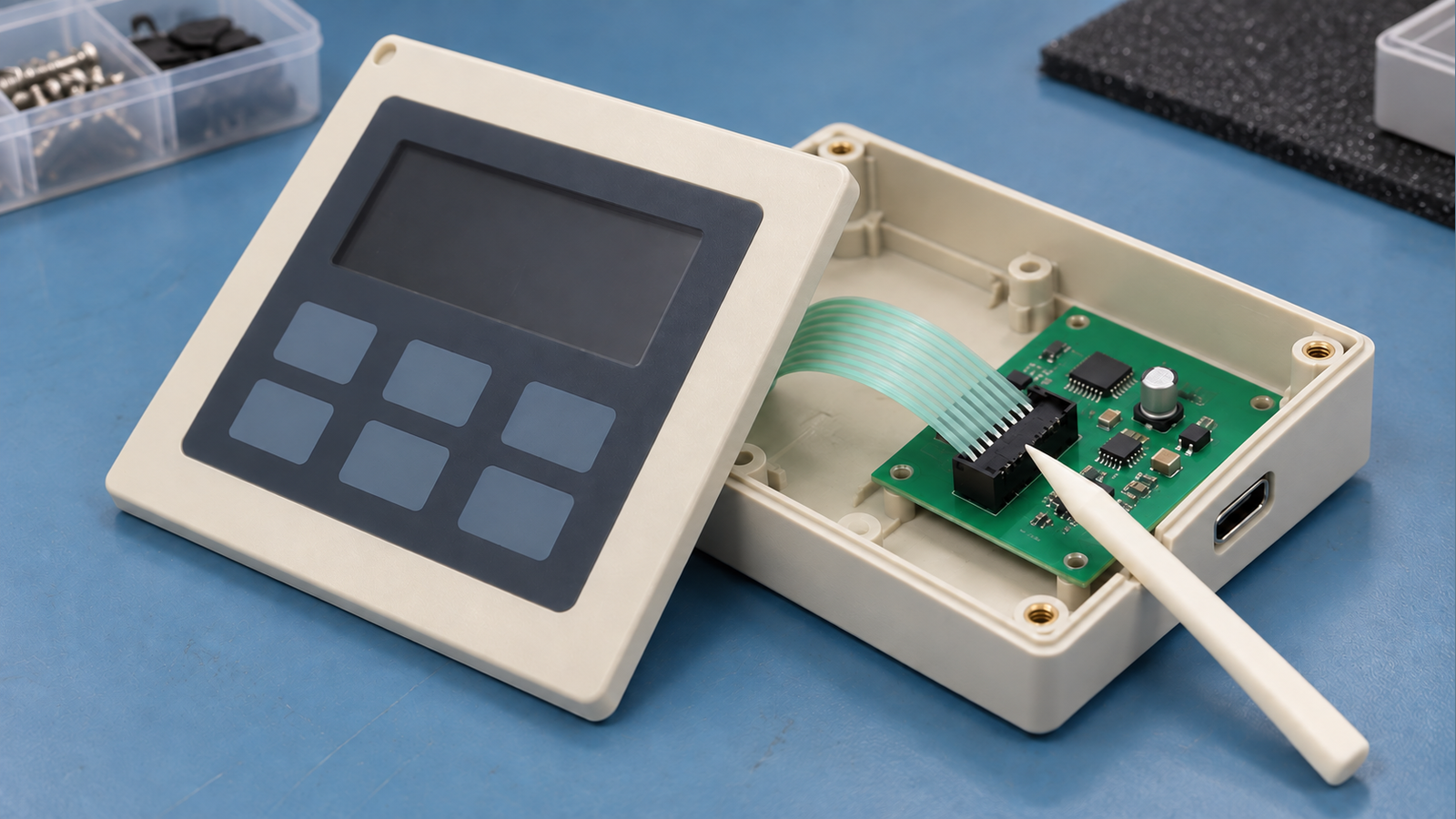
Choose a passive membrane switch when your equipment already has electronics that read its key contacts. Choose a controller-equipped input assembly when the keypad must connect to a computer and deliver recognized USB input. The front appearance does not decide this: the delivered electronics and agreed interface do. For an OEM terminal, a useful first enquiry identifies the host, the required key actions and what hardware already exists. Photos or an early layout can start that discussion. A complete production drawing is not needed to establish the scope, but the quotation should name the assumptions that still need confirmation.
A finished keypad and a switch circuit are different purchases
Logitech's September 8 announcement of its MX Keypad describes a professional physical control device whose value includes customizable actions and integration with coding applications. The release discusses plugins and a software development kit, not merely the shape or number of keys. It is an example of a finished input product being sold together with a defined software workflow.
That distinction matters when an OEM buyer brings a picture of a compact keypad to a component supplier. The picture may explain the desired operator layout while saying little about the electronics behind it. A request to reproduce the front surface and a request to deliver programmable computer input are therefore different purchasing tasks. The launch provides current context for that distinction; it does not identify a membrane-switch construction, establish industrial suitability, or indicate any Baoshengda supply relationship. The discussion below concerns a generic OEM terminal, not a replacement or equivalent for Logitech's device.
Start by deciding where your purchased part should end. It might end at the flexible tail connector. It might instead include a controller board and a host connection. Write that endpoint into the enquiry before comparing prices.
Follow the signal from finger to host
In a passive membrane keypad, pressing a key changes an electrical contact state. The printed or flexible circuit carries that state to the tail. Reading the contacts, filtering contact bounce and translating a press into an equipment action require the receiving electronics and their control logic. An indicator LED, if present, does not by itself turn the keypad into a USB input device.
A USB input assembly adds an active interface. Its controller must communicate with the host using an agreed device behavior. For a design using Human Interface Device support, the USB-IF HID documentation defines the device-class and report concepts used to convey input. A USB-shaped connector alone does not establish that behavior, application compatibility or a working key map.
For example, a membrane keypad for a test instrument might connect to the instrument's existing controller. A similar-looking panel for a PC-based operator station might need a separate interface board. Either can be a valid design. They are not interchangeable quotation scopes, and the membrane drawing cannot stand in for the board and firmware specification.
Compare the delivered assembly, not the key count
Use the comparison below to identify missing scope rather than to rank one construction as universally better.
| Purchase question | Passive membrane-switch scope | Controller-equipped USB input scope |
|---|---|---|
| What leaves the keypad? | Contact circuits, and any separately specified indicator connections, through a tail or connector | Host input generated by a controller, in addition to the switch connections inside the assembly |
| Who reads each press? | The equipment owner's existing electronics or separately sourced interface | The named controller and firmware included in the agreed assembly |
| What defines the key action? | Contact map plus the receiving system's logic | Contact map, firmware mapping and the host application's interpretation |
| What must fit the housing? | Face outline, window, mounting adhesive, tail exit and mating connector | Those items plus board supports, host-port position and cable space |
| What belongs in the price comparison? | Specified switch layers, tactile features, circuit, tail, connector, sample and setup scope | The switch scope plus explicitly included electronics, firmware work, assembly and agreed validation |
A lower component price can be correct while excluding work included in another supplier's assembly price. Ask each quotation to identify supplied items, buyer-supplied items and unresolved interfaces. Keep prototype quantity, one-time setup and expected repeat orders separate. A small first order need not be presented as a committed annual production volume.
Choose the interface before committing the tail
A keypad can use a row-and-column contact matrix or another agreed contact arrangement. A matrix can reduce the number of connections compared with bringing every contact out separately, but the receiving electronics must support the selected scanning method. The required combinations of simultaneous key presses also need review. Do not choose pin count from the face artwork alone.
If your existing board already determines the contact arrangement, send that information with the desired key layout. If the board is undecided, describe the intended host and actions instead of inventing a pin assignment. A supplier can then identify which mechanical and circuit details can be reviewed now and which depend on the interface decision.
For the membrane portion, confirm the tail exit, available route, mating connector and drawing viewpoint together. Leave physical room for a bend and for assembly access. For the active-board option, separately check board support and host-port alignment. A longer tail does not resolve an incorrectly located USB port or an undefined controller.
Approve two different kinds of sample evidence
The membrane sample answers physical and contact questions: does it fit the housing, align with the display, provide the agreed key feel and produce the specified contact result at its connector? Check it on the intended support, not only loose on a desk. Record the drawing revision and the actual mating part used.
A controller-equipped sample must also answer host-input questions. The electronics owner should verify the intended host recognizes it, each required action is reported correctly, and agreed press, hold, release and reconnect behavior works in the target application. A continuity check on the flexible tail cannot establish those results. Likewise, a working USB report does not approve adhesive fit or tactile feel.
Baoshengda's custom membrane-switch design and prototype review covers a route for discussing the face film, circuit construction, tactile structure, tail, connector and mounting requirements. Do not assume a membrane-switch quotation includes a programmed USB controller, application integration or complete equipment qualification. Those deliverables and their responsible parties require explicit agreement. This comparison is not a claim that a generic keypad provides a safety-rated stop function.
Start with the host and the information you already have
For the first discussion, a short description and available images are useful:
- Identify the equipment and whether the receiving side is an existing controller, a computer or still undecided.
- Describe the key actions, any simultaneous presses and indicator behavior you need.
- Share an available layout or front-and-rear photos, approximate space, sample quantity and project stage.
- Say whether you want the membrane component only or need help clarifying the wider assembly scope.
Add the contact map, connector details, housing references, artwork and environmental requirements when available. An indicative quotation should state open assumptions. A fit sample needs agreed critical dimensions and interfaces. Repeat production needs approved revisions and acceptance criteria. These are later decisions, not reasons to withhold an initial enquiry.
Request an OEM keypad scope review with the host description and the information you already have. Ask the response to separate the membrane-switch deliverable, the electronics still needed and the next sample decision. That gives you comparable quotations without pretending an unfinished interface is ready for production.
Need help reviewing a structure?
Send your drawing, photos, application, and quantity. Baoshengda can help check the structure before sampling.
Send Drawing for Quote