
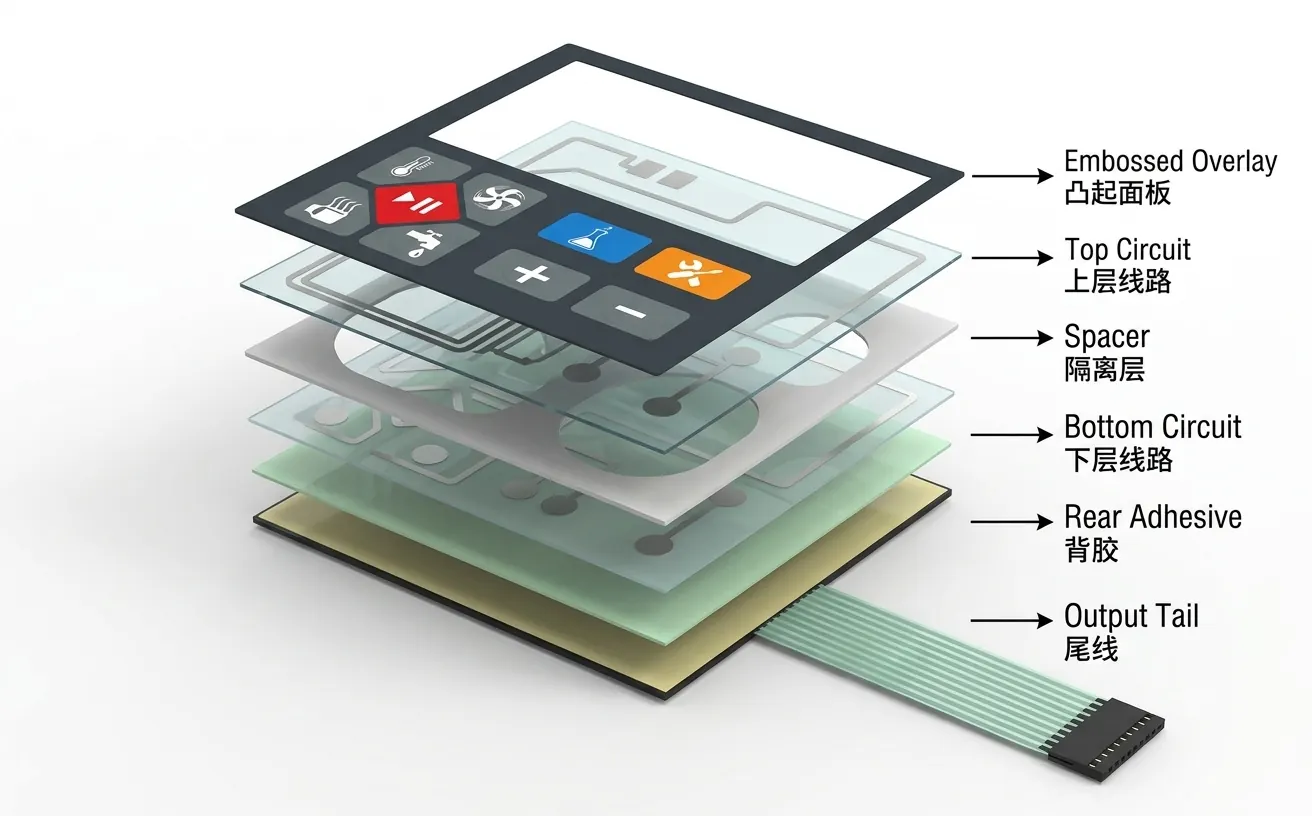
Start with the enclosure and use conditions before choosing a membrane-switch material stack. A PET-versus-PC label is only one input. The overlay film, rear adhesive and circuit answer different questions. A first quotation can name provisional choices, but the buyer should approve the mounted sample against the intended cleaner, housing finish, key feel and electrical interface before production release. The illustration above is a conceptual layer diagram. It does not specify the construction or bill of materials.
Start with what the panel will meet
Tell the supplier where the panel will sit and what can reach its front and edges: routine cleaning liquid, oil, sunlight, condensation, glove use and repeated pressing, as applicable. Give the housing material and its actual surface finish, not just “plastic” or “metal.” A smooth painted metal face and a textured powder-coated face can present different bonding conditions. If exposure or finish is undecided, mark it open in the RFQ rather than asking the supplier to guess a universal “best” film.
Check the overlay against real use
PET and PC are film families, not single performance grades. For either candidate, request the proposed film grade, surface finish, print stack and window construction. Then compare samples under the project's actual viewing, cleaning and pressing conditions. Check printed-legibility wear, window clarity, color, embossing and key feel on the assembled panel. Do not infer chemical compatibility, outdoor life or a cycle rating from the family name or this article.
If the panel needs a display window, state whether it must remain optically clear, diffused or dead-front when unlit. If a raised key is needed, specify the location and feel to evaluate. The material and artwork decision is only useful when those requirements are tied to an inspection sample.
Treat the adhesive as a housing-interface decision
Ask for the actual bonding substrate, coating, texture, usable adhesive land and installation process. An adhesive named on a drawing does not prove it will hold on the production housing. 3M's low-surface-energy bonding guidance explains why some plastics and powder-coated finishes need a different bonding choice and tests on the intended surface. That is general supplier guidance, not evidence that a particular tape is specified for a Baoshengda panel.
For a trial, record how the surface was cleaned, the mounting temperature and pressure, the adhesive landing width, and any edge or cutout that can start lifting. Review the panel after the agreed environmental or cleaning exposure on the actual housing. Keep an edge-lift observation separate from front-film wear: they may call for different changes.
Decide the circuit by routing and the mating connector
A printed-silver circuit may suit a compact, fixed key layout. An FPC construction may be considered when routing density, tail geometry or connector integration makes it useful. Neither is automatically more reliable in every housing. Send the key-to-pin map, tail exit, contact side, connector part number or open connector requirement, and the installed bend path. The buyer's PCB owner should confirm the mating view and input assumptions. A flat continuity check does not prove the tail will remain seated after enclosure closing. The FPC tail sample-approval guide shows the separate mounted-interface check.
New ink options are not approved substitutes
In its electronic-materials announcement dated 2026-10-06, Sun Chemical describes silver inks with increased recycled content, a conductive ink with lower silver content, and LED-curable dielectrics in its printed-electronics portfolio. The manufacturer plans to show these materials at the Berlin event on October 21–22, 2026; the announcement does not report a completed event or a membrane-switch qualification. Its biosensor and stretchable-electronics materials also serve different applications and are not specifications for this keypad.
For an OEM, the useful signal is that the ink formulation and curing route can change while a purchasing description still says “silver circuit.” The buyer risk is carrying an old sample approval over to a different material stack. Recycled content, lower metal content or a new curing option does not by itself establish matching electrical behavior, adhesion or compatibility with the chosen substrate. None of these products is identified here as a Baoshengda production material. Treat a proposed replacement as a documented change: compare its technical data and process requirements, then agree which component checks need new evidence before release.
Record a proposed material change before ordering
Keep the approved construction and proposed replacement side by side. Name the changed layer and the approval it affects. Two generic material labels are not enough.
| Changed layer | Identity and process to compare | Evidence to repeat or resolve |
|---|---|---|
| Overlay film or coating | Supplier grade, thickness, finish, coating and print-side construction | Window appearance, print wear and key feel under the agreed viewing, cleaning and pressing conditions |
| Conductive or dielectric ink | Product identity, compatible substrate, print build and curing requirements | Circuit continuity and insulation checks to agreed limits, plus the installed tail and connector interface |
| Rear adhesive | Adhesive grade, thickness, liner, housing finish and placement process | Bonding trial on representative housing, with edge and cutout review after the agreed exposure |
For a proposed ink change, check the product identity and cure requirements against the approved substrate and print build, then repeat the agreed circuit and installed-interface checks. The table is a review plan, not a universal pass limit. Before building the replacement sample, the buyer and supplier should name the affected checks, acceptance conditions and review owner. If ink and film change together, name both changes; a sample built from the old stack cannot release the new combination.
Send a material decision sheet, then approve a mounted sample
For a first custom membrane-switch inquiry, send the front drawing or sample photos, housing material and finish, cleaner or exposure list, overlay appearance and key-feel goals, connector/tail details, quantity stage and any known failure. Mark unknowns explicitly. Use Request Quote to ask the supplier to list the proposed overlay, adhesive and circuit construction plus assumptions and exclusions. A provisional quotation is not a material approval. For a replacement request, include the approved drawing and sample revision, an old-versus-proposed layer list, any process differences and the acceptance owner for the affected checks.
Before release, put the sample on the intended housing. Compare artwork and window appearance, operate every key, check the connector pin map and tail route, then inspect adhesion and edge condition after the buyer-defined exposure. Record the sample, drawing and housing revisions tested. The buyer defines the final acceptance conditions. If a film grade, coating, ink, adhesive, housing or cleaner changes, revisit the affected material decision instead of treating the earlier sample as universal proof. Keep the accepted construction and sample record with the order; do not silently substitute an open choice during production.
Need help reviewing a structure?
Send your drawing, photos, application, and quantity. Baoshengda can help check the structure before sampling.
Send Drawing for Quote