
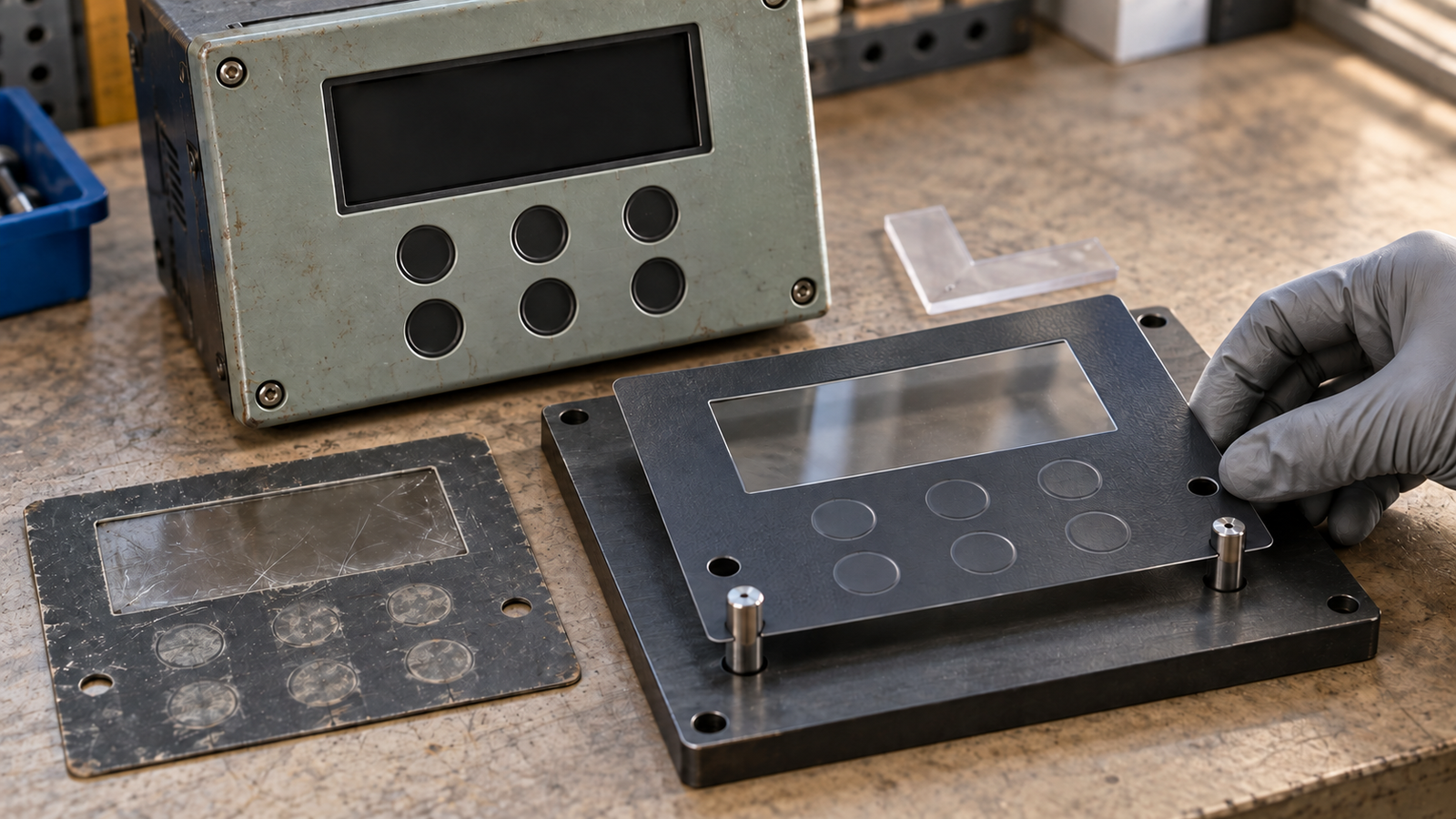
You can start a replacement graphic overlay enquiry with a scan or photograph when the original artwork is missing. It is enough to explain the problem and identify missing information, but not enough to approve production. First confirm whether you need the printed face film only or a complete membrane-switch assembly. Then check the replacement against the actual housing, display opening and key positions. A useful first message includes the images you have, the equipment application, the part condition and the quantity required. Missing dimensions can be listed for review rather than guessed from the picture.
For an industrial HMI that still works, the immediate question is often practical: can the worn face be replaced without ordering the wrong component? Baoshengda's custom graphic overlay and film-panel service is a route for discussing the printed film, windows, embossing, finish and adhesive pattern. State what you want to keep, what has failed and what information is unavailable. The first discussion should establish the component scope and open questions, not treat an incomplete scan as a finished specification.
Check whether the worn face is the part you need
A graphic overlay is the printed outer film. It may carry legends, windows and embossed areas, but an overlay-only quotation does not include the switch circuit underneath it. A membrane-switch assembly can also contain spacers, contacts, domes, a circuit and a flexible tail. Two requests that look identical from the front can therefore have very different supply scopes.
Describe the fault before asking a replacement supplier to copy the appearance. Faded legends or a damaged surface suggest one set of checks. Keys that do not register need a separate review of the switch and electrical path. Replacing the printed film alone does not establish that the key contact, connector or controller problem has been solved.
If you are unsure which construction you have, say so and include front, rear and installed views. Do not dismantle the only working part simply to complete an enquiry. Agree any inspection or disassembly with the equipment owner first.
A scan helps recover artwork; the housing decides fit
A flat scan with a checked scale reference can help recover symbol positions and visible outlines. A handheld photograph also shows wear and the installed relationship, but perspective can distort dimensions. Neither method proves that an old part still has its original shape or finish.
For example, a stretched removed film can move a window edge relative to the display. Copying that edge precisely would copy the wrong geometry. Choose stable references on the housing or its controlled drawing, then locate the cut line, window and key centers from those references. Keep a disagreement between the scan and the housing visible until it is resolved.
Three details deserve attention before a fit sample:
- The viewing window must align with the intended visible display area, not merely with the dark border in a photograph.
- Printed or embossed key positions must align with the operating features beneath the film.
- The adhesive pattern must fit the available housing land and leave specified windows and moving areas clear.
This is why a replacement that looks correct on a bench can still be wrong when mounted.
What is enough for an enquiry, a sample or production?
These are different decisions. You do not need every production detail to start discussing the project, but the open items must remain explicit.
| Decision | Useful starting information | What still needs agreement |
|---|---|---|
| Initial component review | Front and rear images, application, fault description and required quantity | Overlay-only or complete switch scope; missing information |
| Indicative quotation | Available artwork or scan, approximate outline, known material and finish requirements | Written assumptions, exclusions and anything that could change the price |
| Fit sample | Agreed critical dimensions, housing references, windows, key positions and adhesive pattern | Installed checks and how differences will be recorded |
| Production release | Approved drawing and artwork revision, material/finish requirements and accepted sample evidence | Inspection criteria, approved deviations and control of later changes |
This table describes a review sequence, not a promise that every old panel can be reproduced. The project information determines whether a quotation or sample proposal can be offered.
Use the first sample to answer the unresolved questions
Mount the sample on the intended housing and check the full outline, window alignment, key positions and bonding area. Inspect it in its actual installed orientation. A loose film review cannot establish how the enclosure supports an embossed area or how the window looks over the display.
Use an agreed visual reference for color, texture and finish. An aged part may have faded or been exposed to cleaning chemicals, so copying its current color is a choice to confirm, not an automatic reproduction of the original specification.
Keep geometry, appearance and functional checks separate in the sample notes. If a key does not respond, record the symptom and investigate the underlying switch or electrical path rather than automatically blaming the overlay. The acceptance method should identify what was checked, on which assembly and against which drawing or sample revision. Do not invent test values to fill gaps in the original requirements.
Why refurbishment makes this question worth asking
The September 9 Siemens announcement on manufacturer-refurbished automation products includes HMI panels and discusses visual restoration within its refurbishment process. It illustrates the service-life context, but does not specify an overlay construction or establish a Baoshengda supply relationship. The component lesson is to distinguish restoration of the visible face from approval of the complete HMI.
Baoshengda's component review does not replace the equipment owner's electrical, software, safety or conformity decisions. Material suitability, cleaning exposure and mounted performance also need agreed requirements.
Send what you have, and identify what is missing
For the first enquiry, start with:
- Available images or artwork and whether a physical sample can be reviewed.
- The application and whether the request is for the overlay or the full switch assembly.
- The visible damage or functional problem, plus the required quantity and project stage.
Add controlled drawings, housing data, window requirements, finish references and adhesive details when available. If they are missing, name the gap. Keep confidential equipment information out of public comments and agree the appropriate controlled exchange for any sensitive files.
Request a graphic overlay replacement review and ask the response to distinguish what can be assessed now, which details are needed for a sample and which requirements must be approved before production. That gives purchasing a starting point without confusing an early enquiry with a released manufacturing package.
Need help reviewing a structure?
Send your drawing, photos, application, and quantity. Baoshengda can help check the structure before sampling.
Send Drawing for Quote