
If a membrane key returns inconsistently, review its supporting assembly before specifying a different film. Identify what pushes the key back, how the moving part reaches the contact and which housing surfaces can interfere. Record mechanical return and electrical release separately.
A drawing can identify the proposed return mechanism. It cannot show whether the sample in your hand meets the equipment's acceptance requirements. The review steps below are engineering recommendations, separate from the patent's description of its construction.
The four-frame return-support construction
Baoshengda's CN222300514U is a Chinese utility-model grant publication dated 2025-01-03. The original technical pages from CN222300514U include claims, description and drawings; this excerpt retains original pages 2–7 and omits the bibliographic cover page.
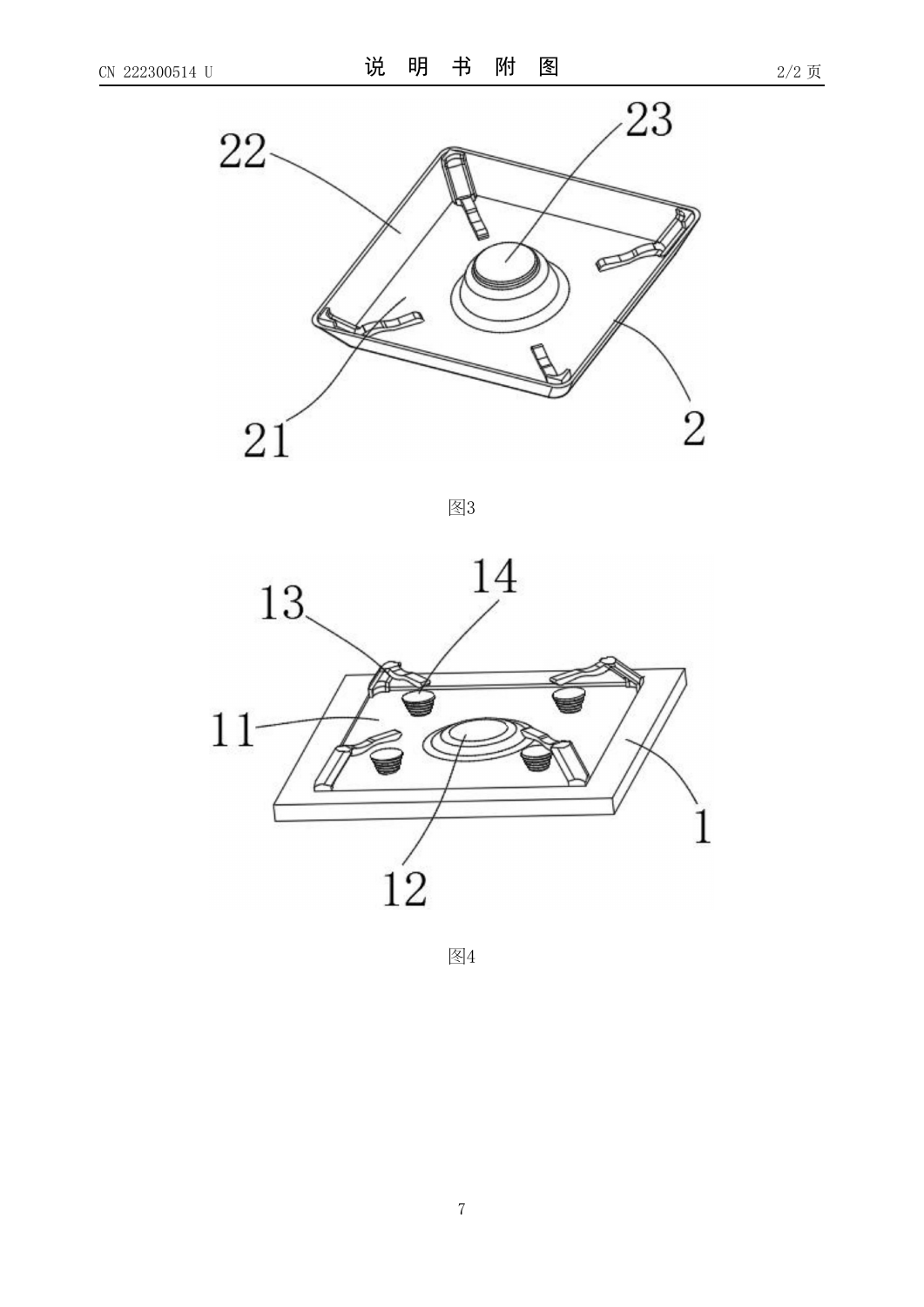
Claim 1 describes a base with a conductive part, a film-key part with top and side films, and a central linkage above the conductive part. Four groups of support frames sit inside the side film and contact the underside of the top film. Claims 2–5 describe inclined L-shaped frames and supplementary spring columns below their end portions. The text calls these columns pedestal-shaped spring seats.
The complete drawing page above contains Figures 3 and 4. Figure 3 shows the underside of the film-key part and central linkage (23). Figure 4 labels the base (1), recess (11), conductive part (12), frames (13) and spring columns (14). Open the original drawing page at full resolution. The illustration is not a photograph of a supplied assembly or a drawing to scale.

Paragraph [0036] describes pressing a hard-plastic press part to move the top and side films and deflect the frames. When the linkage contacts the conductive part, the switch is actuated; after release, the frames and spring columns provide the described reset action. This explains the intended arrangement. It supplies no measured return time or force curve.
Draw the return path before choosing a replacement
Ask the supplier to mark the proposed load path on a section: finger to press part, through the moving key and central linkage, down to the contact; then identify the structures that return the key after release. For the documented construction, the support frames and spring seats belong on that section. Another construction may use a different return arrangement, which needs its own drawing.
Review the support frame, film and enclosure together to establish the available movement. Ask for the required free space around the moving parts and identify where the base is fixed. Check whether an enclosure rib, an adhesive edge or a neighboring component crosses that space. These are questions to resolve on the proposed assembly, not defects demonstrated by the patent.
Keep unspecified dimensions open. The figures do not establish film thickness, frame material, spring rate, installed travel or an allowable side load. Request the supplier's actual section and tolerances rather than measuring proportions from the illustration. A film substitution without that information may leave the same assembly constraint unresolved.
Separate return movement from the electrical result
For a sample review, identify the sample revision and the support used to mount it. Observe whether the key returns without assistance when pressed at the intended location. If users reach the key from an angle or press away from its center, agree those positions before comparing samples. Do not assign an off-center acceptance limit from the undimensioned patent drawing.
Record the key’s visible return and the circuit’s electrical release as separate observations. Use the equipment team's agreed circuit, timing and acceptance method for the electrical check. A visible rise or a felt click does not establish that result. If the appearance and electrical reading disagree, retain both observations instead of describing the sample simply as having good or bad feel.
Change one relevant assembly condition at a time. If the key returns on a loose sample yet fails to return after mounting, compare the support and clearances before changing several materials. Record the observation, mounting condition and drawing revision so the supplier can investigate the same condition. This is a proposed investigation sequence, not a diagnosis of a known customer failure.
Limits for the sample specification
The description attributes improved reset and longer life to the supporting arrangement. It does not report a validated cycle count, test conditions or measured reliability. Four frame groups and supplementary supports are construction details; they are not a purchasing guarantee.
Agree the application's required operating conditions and acceptance evidence separately. The original document does not establish a universal actuation force, stroke, ingress rating or service life. Its grant-publication date is a historical document fact. We have not verified the patent's current legal status or whether this particular arrangement is implemented in a product offered for your application.
This return-support mechanism differs from the layer arrangement in our thin single-key stack guide. That guide addresses installed thickness, bonding and connector space. Neither document should be treated as automatic evidence that the other construction has been supplied or tested.
Start the inquiry with the unresolved return question
For custom membrane switch construction and sample review, explain what the key must do and which assembly condition is uncertain. Useful first information includes where the key is pressed, how its base is supported and whether the concern is movement, electrical release or both.
You can request a membrane-key return review with an existing photo or drawing if available, the intended use, approximate quantity and the unresolved question. A complete production drawing is not required for first contact. Mark unknown dimensions explicitly so the discussion can establish what needs to be measured.
Before approving a change, ask for the identified construction, its revision and the agreed evidence for the condition under review. Keep the mounting condition on that record so both teams review the same assembly.
Need help reviewing a structure?
Send your drawing, photos, application, and quantity. Baoshengda can help check the structure before sampling.
Send Drawing for Quote