
You can start a membrane-switch enquiry without a finished production drawing. Send the drawing or old-part photos you have, the intended equipment and mounting area, an approximate quantity, and the main unresolved question. Mark the missing dimensions or connector details as open. A supplier can discuss a provisional custom membrane switch construction from that package; the quote must state its assumptions. The buyer still needs to approve the mounted sample and final revision before production.
Send what exists, and label what is still open
A current 2D drawing, artwork file or old switch is the best starting point. If none is available, photographs of the front, back and mounting area can show the key positions, visible window and possible tail route. Add the equipment application and whether the request is for a first prototype, a replacement part or a repeat-production revision. Give the sample quantity and an estimated production range separately; if the latter is unknown, say so instead of presenting a guess as a fixed order.
Point out known failures on the old part, if there is one: edge lifting, a cracked tail, faded print, water entry, inconsistent contact or an unsuitable key feel call for different questions. A photo of a failed area is more useful than asking the supplier to copy the part without explanation. Do not send customer-identifying drawings without the right permission.
Identify the part being quoted
If the requirement is only a printed face layer, say so and use the graphic overlay film panel route. If the quote needs key contacts and an electrical tail, identify it as a membrane-switch assembly. A photograph of the front can look similar in both cases, but the scope, sample checks and price are different.
Keep a controller board, USB interface, firmware or complete equipment assembly out of the assumed scope unless it is explicitly included in the written quotation. This is a scope check, not an extra document requirement for the first enquiry.
Show the interfaces that can change the construction
The housing and the electrical connection often decide whether two similar-looking panels can use the same stack. For the first review, identify these interfaces as far as the project allows:
- Mounting surface: housing material, flatness or curve, texture or coating, recess and available adhesive land around keys or a display window. A photo helps, but the buyer should supply measured dimensions for sample approval.
- Key function: artwork or key map, tactile or non-tactile preference, embossing, glove use and any known actuation-force target. A preferred feel is not a verified force specification until a sample is evaluated.
- Tail and connector: exit direction, available bend space, mating-board location and connector part number when known. If the connector is undecided, share a board drawing or a clear photo and flag it as an open choice.
- Use environment: indoor or outdoor placement and likely contact with water, oil, cleaning agents or dust. State actual exposure and cleaning practice before asking for a sealing or material recommendation.
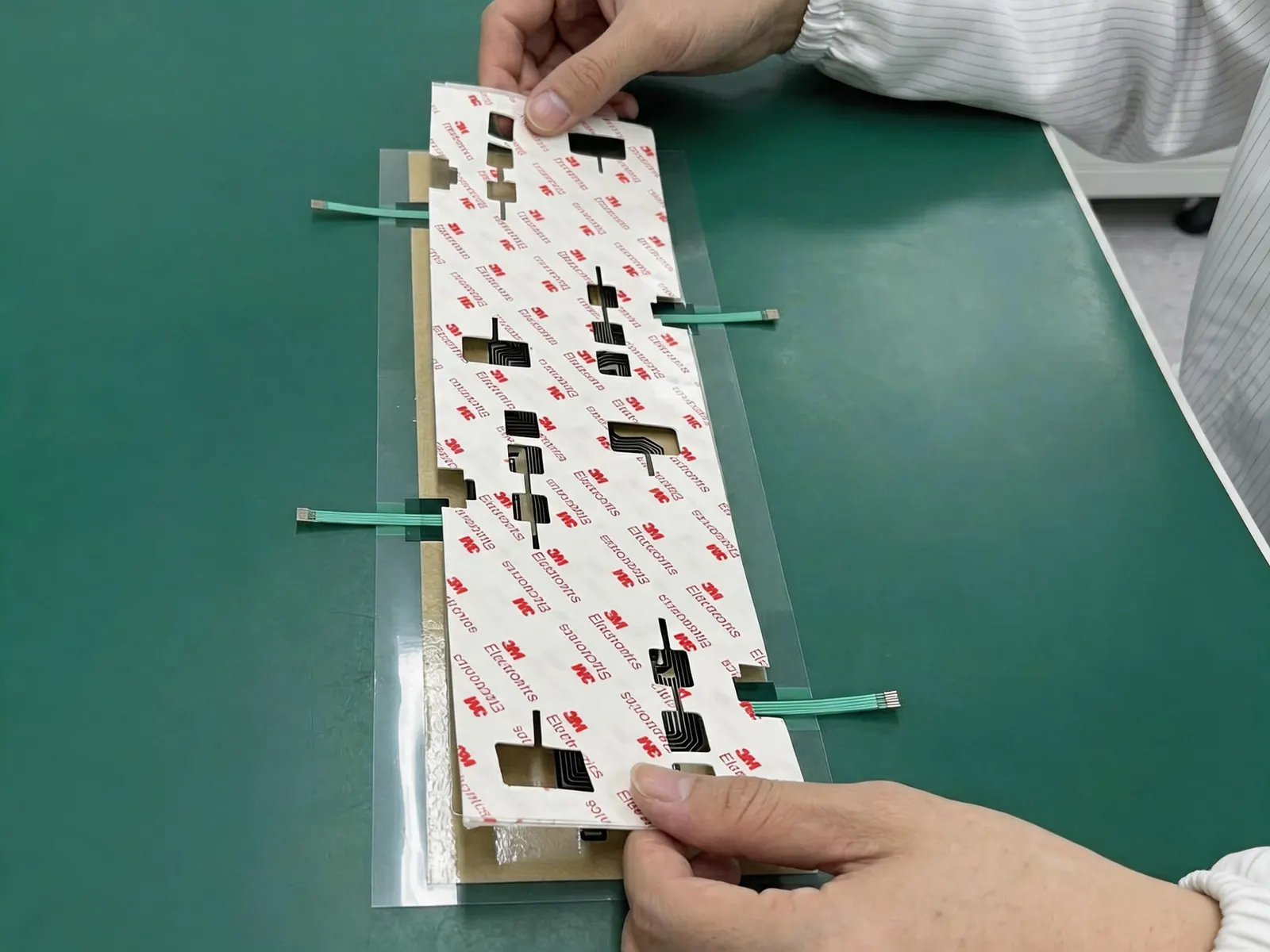
The existing photograph shows the back of a membrane-switch panel with an adhesive release liner, cutouts and several flexible tails. It illustrates why the tail and mounting face belong in the enquiry. It does not demonstrate a passed assembly test, a specified adhesive, or the buyer's eventual installation.
For a wet-use design, the separate waterproof membrane-switch guide explains why edge sealing and the tail exit need their own review. Do not assume the pictured part or a quoted film stack is waterproof.
Ask for a quotation with named assumptions
A useful provisional quotation identifies the revision and quantity being priced and names the choices still open: film or overlay, circuit and key feel, adhesive area, tail geometry, connector and any window or lighting feature. Compare quotations against the same scope rather than comparing a single total that may include different work.
Ask the supplier to distinguish the sample-unit price, any one-time engineering, tooling or setup costs (NRE), and the repeat-production price for the stated quantity. Ask what each charge covers. A later drawing, connector or construction revision may affect the work included. Confirm that before treating an earlier price as valid for the revised part. No fixed charge, free tooling or minimum quantity is promised here.
If a drawing, housing finish or connector remains open, record the assumption in the quote review. State the sample quantity and likely production range separately, even if the latter is only an estimate. An early price is not approval of a final stack or of whole-device performance.
Approve the assembled sample before release
Check the proposed switch on a representative housing: key-to-artwork alignment, edge fit, feel, electrical continuity and tail connection. Add project-specific cleaning, moisture or wear checks where the real use requires them, with acceptance criteria set by the buyer's engineering team. The sample-approval checklist is the next step after the enquiry and quote, not a document that must be complete before the first question can be asked.
For an initial Request Quote, send the files or photographs already available and label the unknowns. Baoshengda can review component structure and sample options. Final artwork, housing fit, electrical interface and release criteria remain to be confirmed on the buyer's approved revision.
Need help reviewing a structure?
Send your drawing, photos, application, and quantity. Baoshengda can help check the structure before sampling.
Send Drawing for Quote